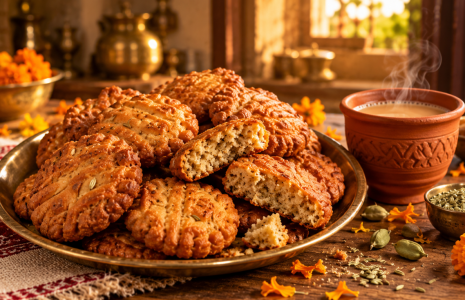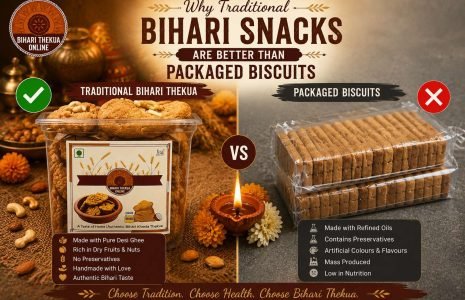
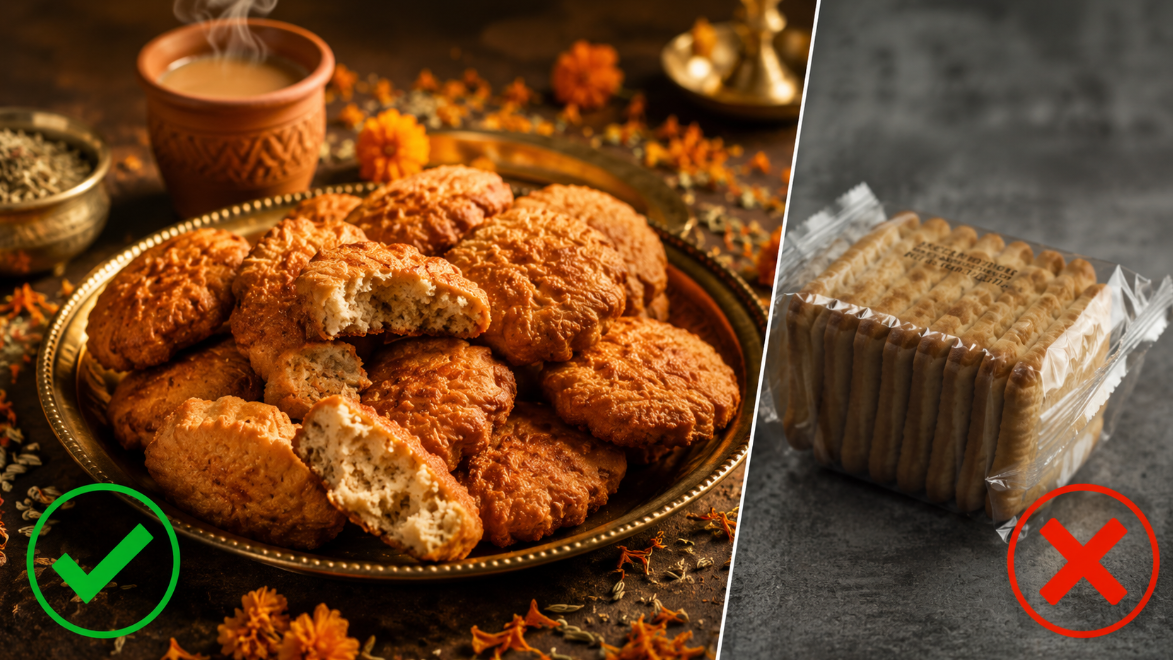
Thekua vs Packaged Biscuits: Picture this: You are sitting with a hot cup of chai. On one side, a shiny plastic packet of biscuits. On the other, a handcrafted piece of golden-brown Thekua. Both promise to satisfy your evening craving. But only one has a 500-year-old story, a family recipe, and ingredients you can actually pronounce.
This is not just a choice between two snacks. This is a choice between tradition and industrial convenience, between real food and food-like products, between your grandmother’s kitchen and a factory assembly line.
Let us break down why traditional Bihari snacks, especially Thekua, are quietly winning the battle against packaged biscuits.
The Rise of Traditional Snacks in a Modern World
We live in an age of convenience. Everything is available in a packet, ready to eat, ready to discard. But something interesting is happening. People are getting tired of eating the same mass-produced biscuits that taste like cardboard and leave a greasy aftertaste.
There is a quiet shift happening in Indian kitchens. Families are rediscovering traditional snacks that their grandparents ate daily, not just during festivals. Thekua is at the center of this rediscovery.
Why? Because it solves a problem that packaged biscuits have never been able to address: the need for real food that actually tastes like something.
When you bite into a Thekua, you taste fennel. You taste cardamom. You taste the rich, unmistakable flavor of pure desi ghee. When you bite into a packaged biscuit, what do you taste? Sugar, maybe. Artificial vanilla. A lingering chemical aftertaste. That is not food. That is a formula.
The Ingredient Test: Can You Read What’s Inside?
Let’s do a simple test. Pick up any packaged biscuit packet from your kitchen. Turn it around and read the ingredients list. Here is what you will probably find:
- Refined wheat flour (maida)
- Sugar
- Palm oil or hydrogenated vegetable fat
- Invert sugar syrup
- Milk solids
- Salt
- Raising agents (ammonium bicarbonate, sodium bicarbonate)
- Emulsifiers (E471, E476)
- Artificial flavors
- Preservatives (BHA, BHT, calcium propionate)
Now look at the ingredients of traditional Thekua:
- Whole wheat flour (atta) or refined flour in some variations
- Pure desi ghee
- Jaggery or sugar
- Semolina (suji)
- Milk
- Desiccated coconut
- Fennel seeds
- Cardamom
The difference is not subtle. The Thekua list contains real ingredients that you can find in any kitchen. The biscuit list contains industrial components designed in a laboratory to achieve a specific texture, shelf life, and taste.
This is the first and most important reason why traditional snacks win. When you eat Thekua, you know exactly what you are eating. When you eat a packaged biscuit, you are trusting a food scientist’s recipe.
The Ghee vs Palm Oil Debate
This is where the nutritional difference becomes personal.
Desi ghee is not just a fat. It is an ancient superfood. It contains butyrate, a short-chain fatty acid that supports gut health and reduces inflammation. It is rich in fat-soluble vitamins A, D, E, and K. It has a high smoke point, making it suitable for frying without forming harmful compounds. Even people with lactose intolerance can often consume ghee because the milk solids have been removed.
Palm oil, which is the primary fat in most packaged biscuits, tells a different story. It is high in saturated fats. When hydrogenated, it creates trans fats that increase bad cholesterol and decrease good cholesterol. Multiple studies have linked palm oil consumption to inflammation, heart disease, and obesity.
The choice is simple: Do you want to fuel your body with something that has nourished generations, or something that was cheap enough for a factory to buy in bulk?
The Sweetener Dilemma: Jaggery vs Refined Sugar
Most packaged biscuits use refined sugar. It is cheap, it is sweet, and it gives the product a predictable taste. But it offers nothing else. No nutrition. No minerals. Just empty calories that spike your blood sugar and leave you crashing an hour later.
Thekua traditionally uses jaggery (gur), which is unrefined cane sugar. Jaggery retains minerals like iron, magnesium, potassium, and calcium. It has a lower glycemic index than white sugar, meaning it releases energy more slowly. It also has a deeper, more complex flavor that works beautifully with the fennel and cardamom in Thekua.
This is not just about sweetness. It is about taste with integrity. Jaggery tastes like something. It has character. Refined sugar tastes like nothing except sweetness.
The Texture Question: Khasta vs Cardboard
If you have ever eaten a Thekua, you know the feeling. The first bite cracks open to reveal a dense, crumbly interior. It is not dry. It is not greasy. It is perfectly balanced. That texture is called khasta in Bihari cuisine, and it is achieved through a specific process of hand-pressing, sun-drying, and slow-frying in pure ghee.
Packaged biscuits, on the other hand, are engineered for uniformity. Every biscuit looks and tastes exactly the same. But that uniformity comes at a cost. They are often dry, chalky, and crumble into dust. They need a sip of chai just to become edible.
Thekua was made for chai. It dips perfectly, absorbs just enough tea to soften without becoming soggy, and still retains its structure. Packaged biscuits either stay too hard or dissolve into a sad paste.
Shelf Life: Natural vs Chemical
How does a packaged biscuit stay fresh for six months? The answer is preservatives. BHA, BHT, calcium propionate – these are not ingredients, they are chemical interventions.
Thekua stays fresh for up to 30 days without a single preservative. How? Because its low moisture content makes it naturally resistant to spoilage. The ghee creates a protective fat barrier. The jaggery binds the remaining moisture, reducing what food scientists call “water activity.”
This is nature doing the work, not a laboratory.
The Cultural Cost of Packaged Biscuits
There is another dimension to this comparison that rarely gets discussed. When you buy a packaged biscuit, you are participating in an industrial food system that puts profit above everything else. The ingredients are chosen for cost, not nutrition. The packaging is plastic that will outlive you. The production process generates carbon emissions at every stage.
When you buy Thekua, you are supporting a different kind of system. You are supporting small-scale production. You are supporting family recipes that have been passed down for generations. You are supporting local ingredients grown by Indian farmers. You are supporting food that has cultural meaning, not just commercial purpose.
Packaged biscuits are transactional. Thekua is relational. It connects you to a place, a tradition, a memory.
Thekua is Famous in Which State?
This question comes up often. Thekua is most famously associated with Bihar, but its reach extends to Jharkhand, eastern Uttar Pradesh, and even Nepal. Wherever Bihari families have settled – from Patna to Pune, Delhi to Dubai – Thekua remains a beloved taste of home.
Thekua is not just a snack. It is the prasad of Chhath Puja, the offering to the Sun God. It is made during weddings, festivals, and family gatherings. It is one of those rare foods that carries emotional weight while also being delicious.
What is Thekua? A Quick Recap
For those discovering it for the first time:
Thekua is a traditional Bihari sweet snack, made with whole wheat flour, pure desi ghee, and jaggery. It is flavored with fennel seeds and cardamom, giving it a warm, aromatic profile. It is handcrafted, slow-fried, and naturally preserved. It is crunchy on the outside, slightly dense inside, and perfect with tea.
It is everything a packaged biscuit is not: honest, traditional, and made with real ingredients.
The Numbers Don’t Lie
Let us look at the nutritional comparison per 100 grams:
| Nutrient | Traditional Thekua | Packaged Biscuit |
|---|---|---|
| Calories | 450 kcal | 480 kcal |
| Total Fat | 22g | 18g |
| Saturated Fat | 11g | 9g |
| Trans Fat | 0g | 0.5-1g |
| Carbohydrates | 55g | 68g |
| Dietary Fiber | 2g | 1g |
| Sugar | 18g | 22g |
| Protein | 6g | 4g |
| Sodium | 15mg | 200mg |
Thekua wins on almost every metric – fewer calories, lower sugar, higher fiber, higher protein, lower sodium, zero trans fats.
What Nutrition Experts Say
Nutritionists agree that traditional snacks like Thekua are a healthier choice than ultra-processed biscuits. The whole wheat flour provides dietary fiber. Jaggery offers small amounts of iron and minerals. Desi ghee provides healthy fats.
However, a balanced perspective is important. Thekua is still a deep-fried sweet treat, so moderation is key. Enjoying a small portion with tea is a sustainable way to include it in your diet without overdoing it.
The point is not that Thekua is a health food. The point is that it is real food, which is already a major upgrade from the chemical-laden alternatives.
How to Enjoy Thekua
If you are new to Thekua, here is how to enjoy it:
- With evening chai – The classic way. The crunch of Thekua with the warmth of tea is unmatched.
- As Chhath Puja prasad – The traditional way. Thekua is the main offering during Chhath Puja.
- As a travel snack – It stays fresh for weeks and doesn’t crumble easily.
- As a gift – Packaged beautifully, Thekua makes a thoughtful festive gift.
Conclusion: Choose Taste, Choose Tradition
The comparison is clear. Traditional Bihari Thekua offers better ingredients, better nutrition, better taste, and better cultural value than packaged biscuits.
Packaged biscuits represent industrial efficiency. Thekua represents culinary heritage.
One was designed in a factory. The other was perfected in a grandmother’s kitchen.
When you choose Thekua, you are not just choosing a snack. You are choosing to support real ingredients. You are choosing to honor centuries of tradition. You are choosing food that actually tastes like something.
The next time you reach for that biscuit packet, pause. Remember that there is a better option. Remember that traditional snacks like Thekua are not just nostalgic – they are genuinely better.
Taste tradition. Taste Thekua. Support real food.
FAQs
What makes Thekua healthier than biscuits?
Whole wheat flour, pure desi ghee, and jaggery replace the refined flour, palm oil, and sugar found in most biscuits. Thekua also has zero preservatives.
Does Thekua contain maida?
Traditional Thekua is made with whole wheat flour. Some variations may use maida, but authentic recipes prioritize whole wheat for better nutrition.
How long does Thekua stay fresh?
Up to 30 days when stored in an airtight container at room temperature, without any preservatives.
Can Thekua be eaten every day?
Like any sweet snack, it is best enjoyed in moderation. One or two pieces with tea is a reasonable portion.
Where can I buy authentic Thekua online?
Bihari Thekua Online offers authentic Thekua made with pure desi ghee, handcrafted in small batches, and delivered fresh across India.